"We can’t afford to pay for a parallel school system. The taxpayers are going to be on the hook for more than they bargained for.”
– Steve Kestell, former state representative, Elkhart Lake (2013)
Introduction
Over a decade ago, Steve Kestell, 16 year Republican Wisconsin legislator, supporter of school choice, and former Chair of the Assembly Committee on Education, warned fellow legislators about the potential “fiscal mess” the state could find itself in without careful analysis of the costs, impacts, and tradeoffs of expanding Wisconsin’s voucher programs. Kestell’s concerns continue to provide important context for ongoing debates about how and whether to adopt changes to Wisconsin’s publicly funded private voucher programs.
In 2024, legislators proposed AB 900/SB 838. Nicknamed “decoupling bills,” they would have shifted voucher funding from local property tax levies and school district state aid calculations to funding them directly through state general purpose revenue (GPR). Although those bills failed, similar bill drafts are under consideration in 2025.
In this article, WASBO draws on our expertise in research and analysis on education finance and policy to examine the potential fiscal impacts of so called “decoupling” proposals as well as the big-picture impacts such changes to the state’s voucher funding system could have on public schools and the overall state budget for years to come. We draw on observations of the history and impacts of Wisconsin’s voucher programs as well as the trajectory of voucher expansion in other states.
Contrary to the notion that the term “decoupling” refers to a small fix to correct a simple problem (i.e., an “accounting quirk”), we find that such proposals could contribute to the expansion of vouchers in Wisconsin without contending with the significant surge in costs they could impose on the state budget and Wisconsin taxpayers or the policy tradeoffs such costs would require.
Although the word “decoupling” has become convenient shorthand to refer to these proposals, this discussion favors language that more accurately captures what is actually happening with the funding and that describes the potential for far-reaching fiscal impacts for the state and its fiscal capacity to support K-12 education.
A growing body of research raises concerns that voucher programs in operation today do not generally improve student achievement compared to traditional public schools and in many cases can worsen student academic outcomes. Given the importance of educational impacts in how best to steward public education dollars, attention to these concerns and analysis of the educational outcomes in Wisconsin’s voucher programs deserves careful examination.
However, in this discussion, we focus more narrowly on funding considerations and the fiscal impacts of voucher programs and their potential expansion on public schools and on the state as a whole.
Background: Funding for Wisconsin’s private school voucher programs
Wisconsin’s voucher programs include (in chronological order) the Milwaukee Parental Choice Program (MPCP), the Racine Parental Choice Program (RPCP), the statewide Wisconsin Parental Choice Program (WPCP), and the Special Needs Scholarship Program (SNSP).
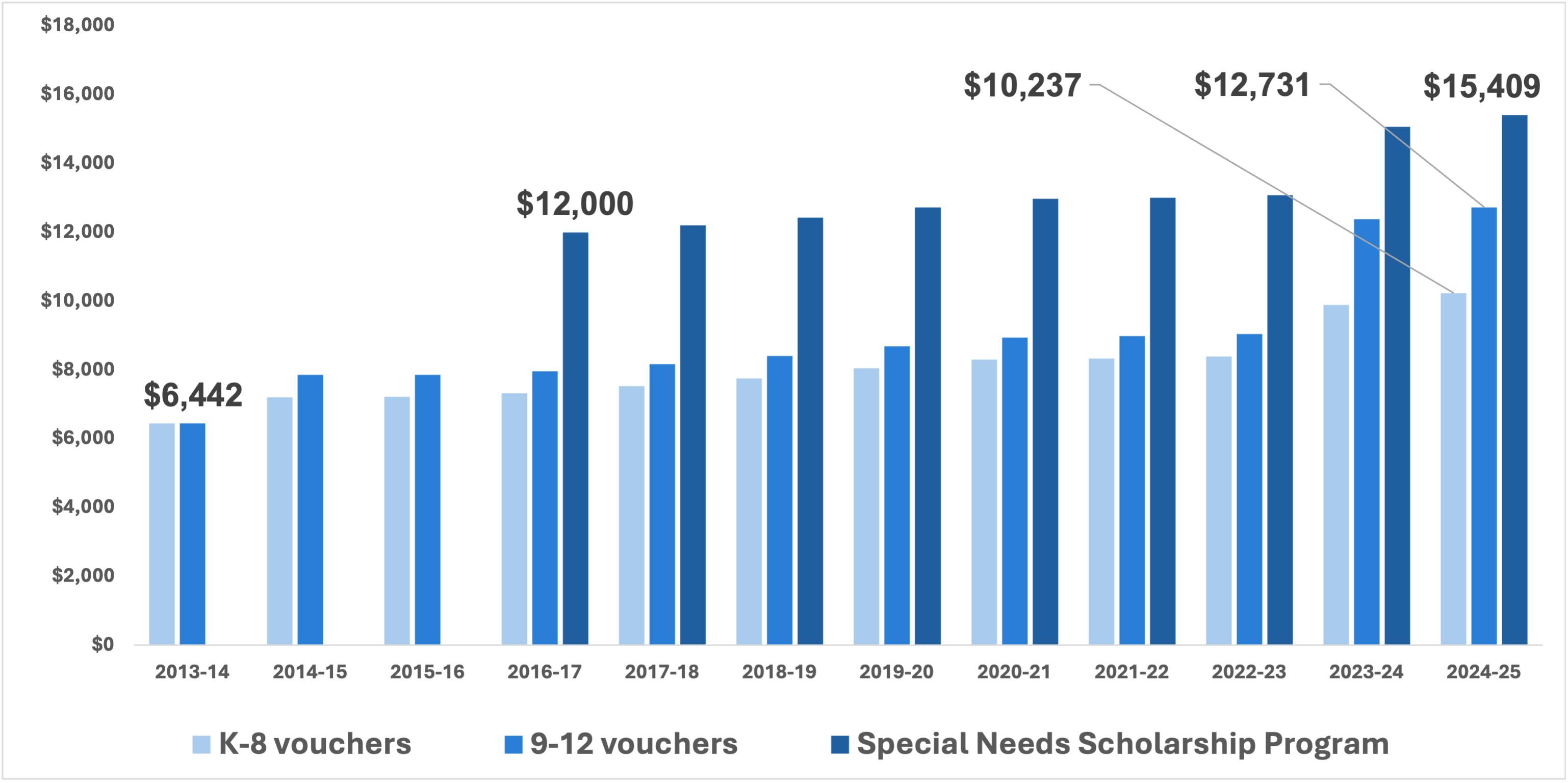
Figure 1: Wisconsin voucher programs:
Per-pupil payments (2013-14 to 2024-25)
Source: Wisconsin Department of Public Instruction. Fiscal impacts – Private School Choice Programs, Special Needs Scholarship Program
The four programs were implemented at different times, and their funding mechanisms have changed over time. The MPCP, the first modern voucher program in the country, was originally funded with state GPR. It was then shifted to a state-local cost-sharing method as the program grew, and is now, once again, funded exclusively with state GPR. Initial voucher expansion in the Racine and statewide programs similarly began as state GPR programs.
However, those two programs, along with the special needs voucher, are now paid for by reducing the state aid of resident school districts and allowing them (in most cases) to replace the lost aid by charging property taxpayers. In the following year, school districts count resident voucher participants in their state aid calculations, which allows them to offset some of the property tax impacts from the prior year.
Voucher program costs are significant (especially relative to other K-12 education priorities). Figure 1 shows how the per-pupil payments for voucher participants have grown over time from $6,442 in 2013-14 to upwards of $10,000 in 2024-25, depending on what kind of voucher a student is taking. Notably, the $12,731 per pupil price tag for voucher high school students is higher than the revenue limit per pupil in 359 of the state’s 421 public school districts.
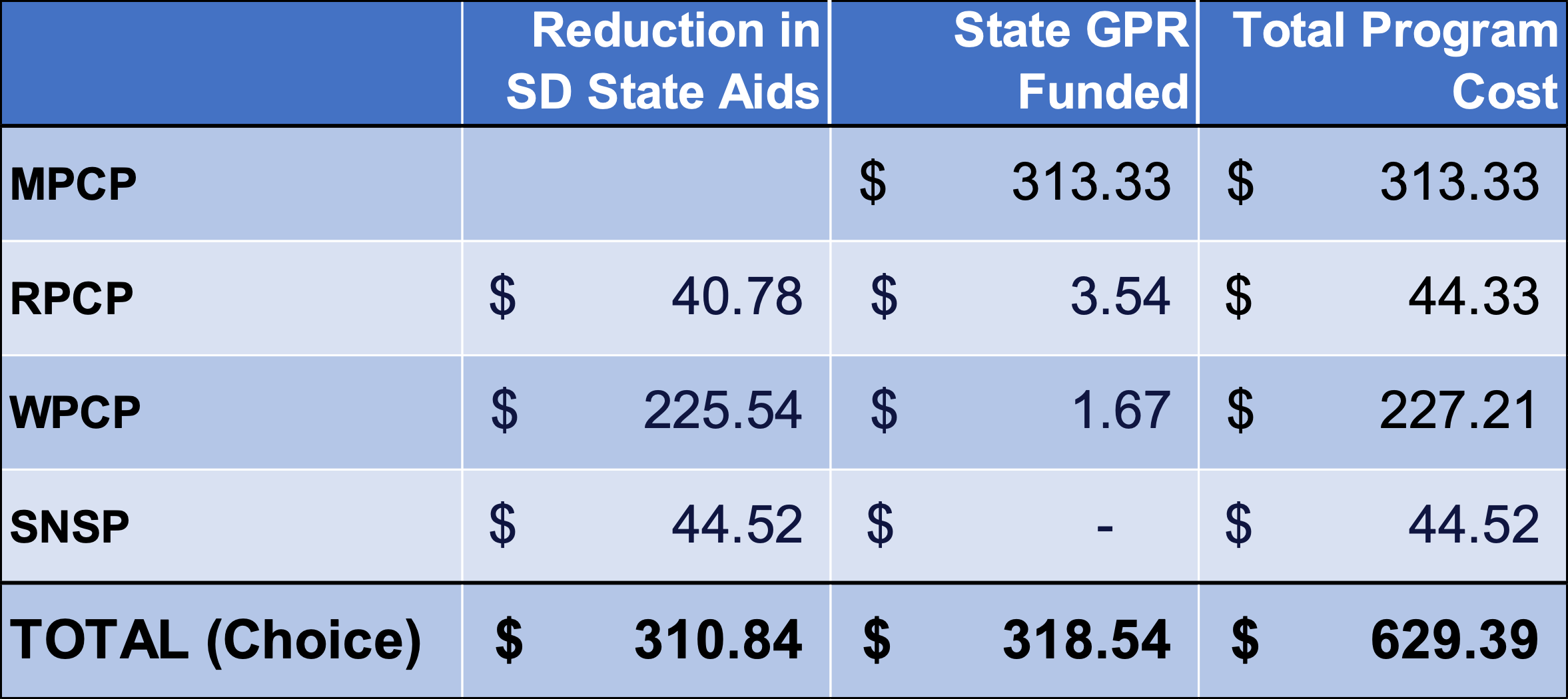
Figure 2 shows the estimated total cost of Wisconsin’s voucher programs in 2024-25. As noted, state GPR already covers all of the Milwaukee program and small portions of the RPCP and WPCP (due to earlier funding mechanisms) for a total estimated cost to state GPR of $318.54 million (approximately half the total costs of all voucher programs). The remainder of the programs’ costs are paid for using the current state-local shared cost approach for a current-year local tax levy cost of $310.84. Altogether, Wisconsin spends a combined total of about $629 million for its four voucher programs, which serves 58,623 students in 2024-25.
As a point of comparison, the state appropriation for special education categorical aid for state and federal mandated services for the 126,830 students with disabilities served in public schools (arguably the top unmet funding need for Wisconsin K-12 public schools) for the same period is $574.8 million. This is $54.6 million less than the cost of the state’s voucher programs.
Figure 2: 2024-25 estimated costs of Wisconsin private school voucher programs ($ millions)
Source: Wisconsin Department of Public Instruction. WASBO calculations
The disparity in these allocations of public monies raises concerns, especially given that voucher programs — unlike public schools — are not mandated either at the state or federal level.
Special needs students require support for a broad array of disabilities whose costs vary widely by school district, and state aids cover less than a third of the additional costs districts incur to serve them. This shortfall is so severe that many school districts attribute it to their need to seek additional funds through operating referendums.
Some voucher proponents assert the per-pupil costs for voucher schools are lower than traditional public-school costs and accrue cost savings for the state. Apart from the methodological problems that have been observed regarding such claims, there are two main reasons why this argument lacks credibility.
First, the majority of voucher recipients statewide are in fact switching from private schooling at personal family expense to private schooling at public expense (using a taxpayer-funded voucher) – adding to, not reducing, the cost to taxpayers statewide. This is the concern that raised particular alarm for Representative Kestell when he called on fellow lawmakers to address what he saw as an inevitable emergence of two parallel school systems for which Wisconsin taxpayers would be on the hook. In fact, it has been reported that about two-thirds of voucher recipients in the first two years of the WPCP were already attending private schools. As of 2024-25, 95% of WPCP enrollment consists of students who did not attend a public school in the previous year.
Second, because public schools provide a free and appropriate public education for all students without exception, the scope and accountability of mandated programs and services in public schools (e.g., special education services, student transportation, licensed educators, and many other functions, and standards) is more rigorous and comprehensive than in a typical voucher-funded private school setting. Further, public schools are required to provide transportation and special education services to private school students, whether or not they attend a voucher school.
Like the “decoupling” bills introduced last year, a pair of preliminary draft bills under consideration in the current legislative session would shift the cost of the voucher (and independent charter school) programs from the school district tax levy/general aids calculations and add the full cost to the state budget using GPR. These proposals include what the Legislative Fiscal Bureau calls a “one-time recurring revenue limit adjustment” for school districts equal to 25% of their 2024-25 voucher/charter-related aid reductions (which, importantly, could be changed or revoked by legislation at any time in the future).
Funding vouchers at the state level: Immediate versus long-term considerations
It should be acknowledged that, from a short-term district budget perspective, the prospect of shifting voucher funding from school district finances could, in some ways, alleviate a number of fiscal challenges and simplify the calculation and communication of aid and property taxes.
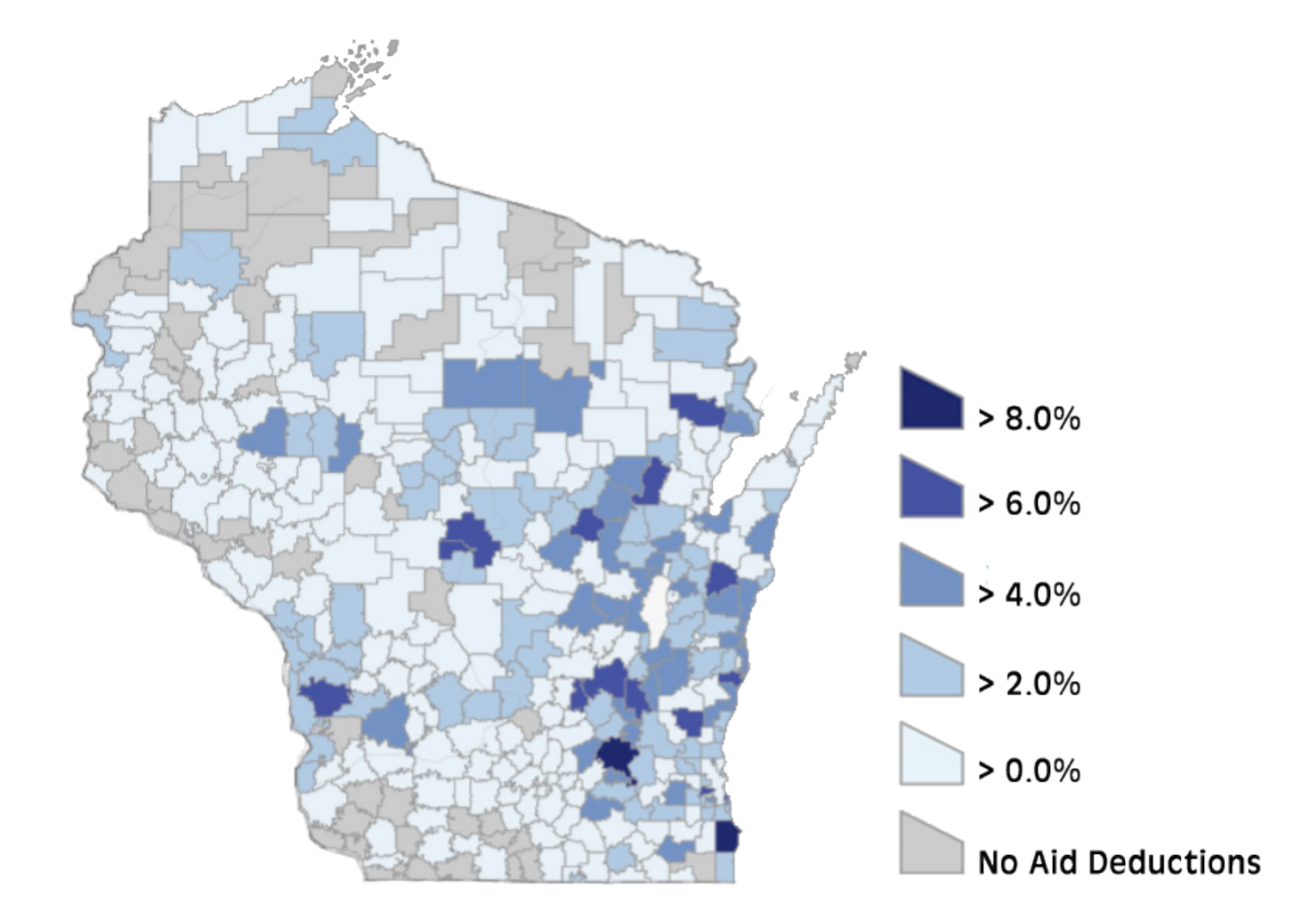
Although school districts are “made whole” by being allowed to use property taxes to replace the aid deduction that the state uses to pay for vouchers, it nonetheless adds, sometimes significantly (see Figure 3), to the amount school boards are forced to levy in local property taxes every year to fund the education of students who attend schools they were not elected to govern.
Figure 3: Percent of district revenue limit allocated to voucher state aid deductions (2023-24)
Source: Wisconsin Department of Public Instruction. Summary of 2023 Act 19 (2023-25 Biennial Budget) for K-12 School Aids
This is a significant challenge to districts from a fiscal planning perspective as they do not know how much they will have to levy to replace voucher aid deductions until the fall of the current school year. This is a volatile variable (over which districts have no control or insight) in the otherwise year-long, painstaking effort to calibrate how much property taxes they need to raise to achieve the community’s educational goals.
Because voucher costs are factored into the state’s complex equalization aid formula (a purpose for which the formula was not designed), they redistribute state aid amongst the state’s 421 school districts in ways that can be difficult to predict and which are not necessarily aligned with the purpose of the formula, which is to equalize the tax base among school districts (i.e., equal tax rates for equal per pupil spending).
All of these factors add to already unsustainable fiscal conditions for many school districts. However, the alternative – tucking the cost of vouchers inside the state budget, effectively hidden amongst every other spending priority across the state from all but the most savvy of taxpayers – could be even more harmful in the long run.
To begin with, unwinding the existing voucher funding method from a state-local cost-sharing model to be 100% funded through state GPR would also have unpredictable distributional effects that could benefit some districts in terms of state aid but could be detrimental to others. In other words, even from an immediate practical perspective, “decoupling” would arbitrarily create both winners and losers among the state’s 421 school districts.
But even these concerns fail to address the potential lasting fiscal harms of shifting all voucher funding from the current state-local mix to state general purpose revenue. The larger, long-term concern that policymakers will need to address is the potential for “decoupling” to help facilitate unfettered growth in spending on a parallel system of private K-12 schools that are not evenly distributed across the state and that would require additional funding from a state budget that over the past 20 years has been cutting the share of GPR it directs to public schools.
Relative to inflationary cost pressures and a growing list of underfunded mandates, the current funding mechanisms for public schools have left them under-resourced for decades (conditions that arguably have driven growth in operating referendums in recent years). Lawmakers will need to carefully consider how to balance voucher funding with the need to provide adequate and equitable resources for the state’s constitutionally guaranteed public schools.
Potential impacts of the state paying the full cost of vouchers: Analysis and discussion
The stated goal of voucher proponents in Wisconsin is universal access or “a voucher in every backpack,” despite a reasonable expectation that future costs could grow significantly. Wisconsin has been on a steady path toward universal eligibility. (This is not the same as universal access, as voucher schools are not required to enroll eligible students. As such, students are not guaranteed attendance at the school of their choice for a variety of reasons.)
Eligibility for vouchers has expanded in terms of both geographic footprint (i.e., Milwaukee, Racine, and statewide) and student eligibility (e.g., lifting of participation caps, broader income eligibility; access for students with disabilities with no income restrictions; and other flexibility).
To achieve universal eligibility for private school vouchers, at least three statutory constraints on voucher expansion would need to be eliminated. One is already set to expire in 2026-27. These constraints are as follows:
- School district enrollment limitation: For 2024-25, no more than 9% of a school district’s enrollment can participate in the WPCP. The limit per school district will go up to 10% next year (2025-26), after which time the limit will be lifted entirely.
- Income eligibility: Students’ family income must be at or below 220% of the federal poverty level to be eligible for the WPCP (300% for MPCP and RPCP). Importantly, however, after qualifying based on income in the first year of participation, students who are continuing in the program from previous years or were on a waiting list do not have to continue to demonstrate income eligibility.
- Application grade requirement: Students applying to the RPCP or WPCP must be applying to grades K4, K5, 1, or 9, or meet other alternative criteria.
As a practical matter, a fourth constraint that the current system imposes on potential voucher expansion is the fact that the cost for resident students to attend private schools using publicly funded vouchers is reflected on property tax bills. And the district property tax levy, inclusive of voucher costs, is an explicit topic of public discussion in statutorily required school district annual meetings. As such, the inclusion of the cost of voucher schools on property tax bills provides an important measure of transparency and tangibility for both school board members and local property taxpayers.
The value of maintaining at least a portion of the costs of voucher schools in the communities where participating students live is bolstered by the fact that private schools, irrespective of their participation in any of the state’s voucher programs, are not evenly distributed across the state.
This means not every community has access to private schools as an educational option. Although the current funding system can distribute state aid in a way that penalizes the property taxpayers in some districts with few or no voucher students or schools, shifting voucher costs entirely to state GPR would ensure that taxpayers across the state would be paying for vouchers regardless of whether they have schools that participate in the voucher program.
But there are some areas of the state where voucher school presence is minimal or absent altogether and other areas where the impact is much more concentrated. Shifting payment for vouchers to an appropriation in the state’s overall general fund would remove this important layer of transparency, accountability, and monitoring of taxpayer impacts.
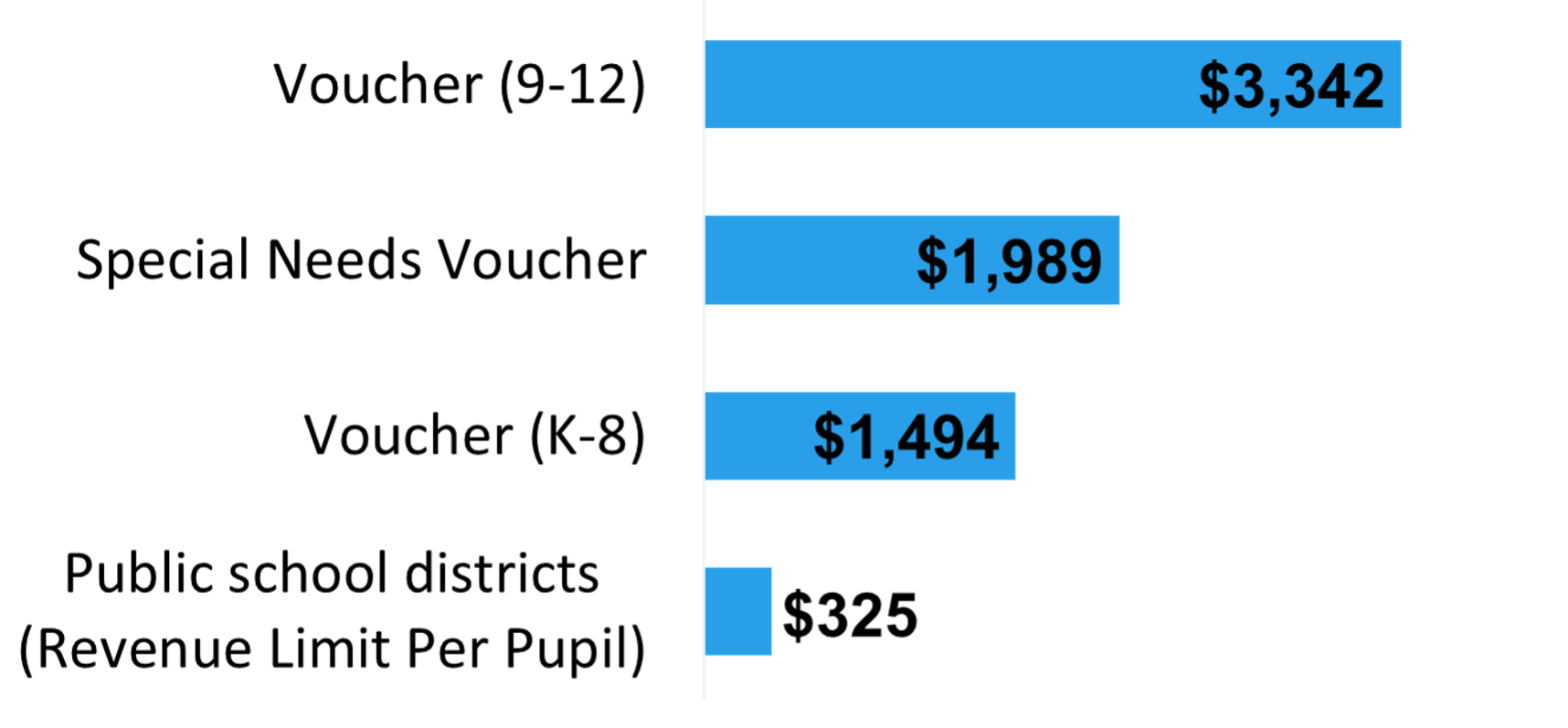
A key driver of recent increases in the growth of public dollars flowing to voucher schools is a provision in current law that ensures every voucher school’s payments increase with increases the legislature adopts for public schools, even if only a subset of public schools’ funding increases. For example, in the 2023-25 legislative session, lawmakers increased the minimum revenue limit per pupil a school district can receive by $1,000, making sure school districts received no less than $11,000 per pupil (with a few exceptions). As a result, every voucher school received a sizable increase ($1,000 per pupil for voucher high schools and SNSP schools, and $900 for K-8 vouchers), while only certain school districts saw any increase at all, many by much less than $1,000. Proponents of “decoupling” are not calling to eliminate this particular link between public and voucher school funding systems.
Figure 4: 2023-24 change to per pupil payments over prior year
Source: Wisconsin Department of Public Instruction. Summary of 2023 Act 19 (2023-25 Biennial Budget) for K-12 School Aids
Figure 4 shows the increase in regular operating dollars in 2023-24 over the previous year as a result of funding levels and mechanisms that were adopted for voucher and public schools during the 2023-25 legislative session.
School boards vote on their district’s tax levies every October, which includes the cost of vouchers in the district, if any are present. Although efforts to clearly list the voucher portion of the school levy on property tax bills often have been opposed, largely by voucher proponents, school district leaders have begun to use multiple other communication methods to ensure that the costs to property taxpayers of publicly funded vouchers is as clear to see as possible.
Especially in the context of potential voucher expansion, if state GPR covered the full cost of voucher schools, it would eliminate the public’s ability to monitor the geographic concentration of voucher participants and where the immediate tax impact is most pronounced.
It also would redistribute the fiscal impact of the voucher program across the entire state, rather than focusing it, at least in part, on the communities where the participating students live.
Finally, it would make public schools the only K-12 schools imposing an explicit cost on local residents through property taxes. Meanwhile, taxpayers would still have to pay for the cost of voucher schools, principally through income and sales taxes that fund the state budget.
This would make the fiscal impact of voucher schools effectively imperceptible to the typical taxpayer and could give the inaccurate impression that public schools are costly to taxpayers while voucher schools are free.
What can Wisconsin learn from other states where voucher programs have expanded?
Wisconsin already ranks third among states with the highest proportion of state education dollars used in private schooling options in 2024-25 (9%). The states in the top two spots, Florida (22%) and Arizona (12%), provide instructional and cautionary examples of states that now confront a major budget shortfall because lawmakers agreed to expand private vouchers without first facing up to the true cost and spending tradeoffs required to fund expanded voucher eligibility.
- Florida’s universal voucher program, the largest and most costly in the country, will draw $3.9 billion in state funds in 2024-25. This is up from $3.2 billion in 2023-24. The share of state education dollars it diverts almost doubled from 12% in 2021-22 to almost a quarter (23%) in 2024-25. This trend might explain why Florida, after years of operating with sizable budget surpluses, is projecting a $2.1 billion surplus in 2025-26 and a $6.9 billion deficit by 2027-28.
- When Arizona projected the cost of expanding its voucher offerings to establish the nation’s first universal voucher program, state spending was estimated at $33 million in 2022-23 and $64 million in 2023-24. In fact, by the end of 2023-24, the cost soared beyond budgeted appropriations to $738 million (an increase of more than 660%). Costs continue to rise, crossing the $1 billion mark in 2024-25 with no clear estimate of how much larger the program could grow. This, even as Arizona now faces a $1.4 billion deficit which is attributed in large part to the voucher program expansion and a major tax cut. Already ranked 49th in the nation on per pupil spending on public education, Arizona has been forced to make significant cuts to public schools and many other essential state programs.
Despite the fiscal crises universal voucher programs have helped precipitate in Florida and Arizona, they still are serving as the model for a rapidly growing wave of other states that have introduced, ramped up, or have future plans to propose or implement universal voucher programs since 2023, including Alabama, Arkansas, Idaho Indiana, Iowa, Louisiana, Mississippi, North Carolina, Ohio, Oklahoma, Tennessee, Texas, Utah, and West Virginia.
In light of this, a key question for Wisconsin policymakers to address is what such a ramp-up would look like in Wisconsin. Projecting future costs of a new or enlarged program can be complex. However, we can reach a conservative figure of what it would cost if only current private school students, whose families already pay for their children to attend private schools, began instead to use a taxpayer-funded voucher (as was observed in the Florida and Arizona universal eligibility expansions).
Based on 2024-25 private school enrollment figures and statutory per pupil voucher payment amounts for regular voucher programs (not counting any growth in the SNSP or take up by current public school students), a “voucher in every backpack” for current private school students only would cost a total of $1.3 billion dollars per year (not inflation adjusted), $683.0 million more than the current combined costs at both the school district and state GPR level.
Meanwhile, Wisconsin’s ranking has fallen considerably relative to other states on per pupil spending on K-12 education – from 11th in 2002 when the state was spending 11% above the national average, to 25th in the nation in 2022 with spending at 7% below the national average. This is the result of a sixteen-year pattern of sub-inflationary funding for public schools, where 83% of Wisconsin students are educated.
In this fiscal environment, an additional draw of almost $700 million per year on state GPR demands extremely careful consideration to ensure those dollars address the state’s highest educational priorities and responsibilities and that policymakers have fully grasped what the state will not be able to pay for as a result.
As illustrated, a “decoupling” bill would mask the cost of vouchers at the local level and the negative attention it has come to generate from property taxpayers (that is, it would reduce transparency). The explicit purpose is to shift voucher costs off local school tax levies (i.e., the local communities where voucher participants live) to the state general fund (i.e., distributing voucher costs across all Wisconsin taxpayers, no matter what the level of voucher participation in their communities, if any).
The recent timing of proposals to return to the prior funding method coincides with arguments made by voucher proponents that it would insulate the voucher program from constitutional challenge, allowing it a clearer path toward expansion.
The relatively sudden concern related to constitutional scrutiny has arisen amid recent court rulings in other states that have blocked voucher programs’ use of property tax revenues on constitutional grounds.
Any proposal that smooths the path to universal eligibility for vouchers, especially without a financial plan that does not harm public education, raises concerns for both public schools and proponents of fiscal restraint. Should state-funded vouchers continue to grow at current levels or expand more rapidly as a result of fewer or no constraints on eligibility, lawmakers would need to find a major recurring funding source.
Absent a tax increase effectively enlarging the pie of available dollars (to which state policymakers have signaled strong opposition), funding for vouchers would need to come from reallocation of state budget funds.
This would inevitably pull resources from other state priorities. In such a reallocation scenario, funding cuts or smaller shares of state funding for constitutionally guaranteed public schools would likely be hard to prevent because K-12 education aid is the largest category of state GPR spending. This has been consistently observed in other states that expanded their voucher programs.
Wisconsin lawmakers would be wise to study the significant financial challenges other states are facing to prevent Wisconsin from joining the ranks of states that allowed voucher programs to expand before careful analysis of their fiscal and educational impacts.